







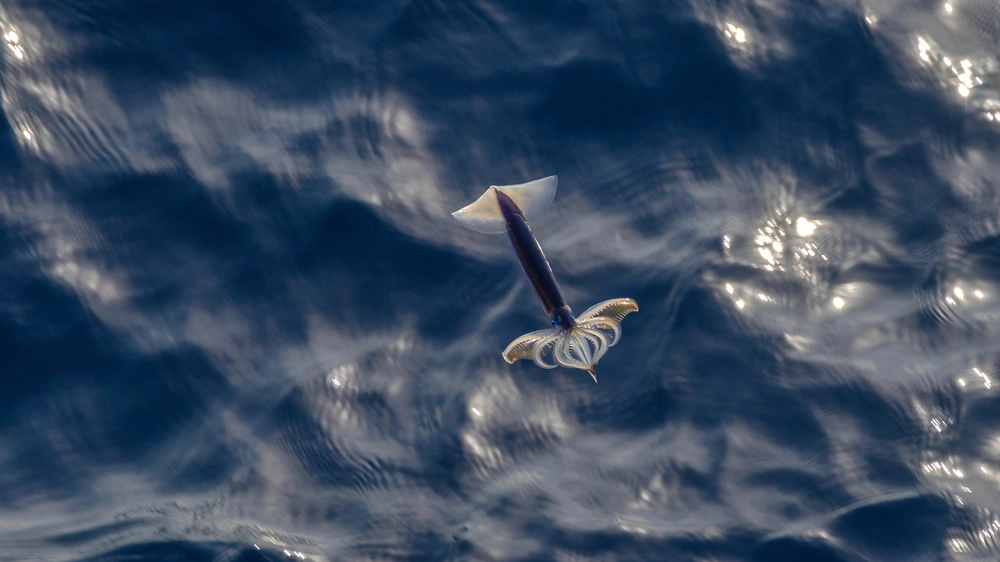
Many people are familiar with flying fishes, but probably very few have heard of flying squid. Flying fishes can leap out of the water with powerful fin beats and then glide for long distances using their large pectoral fins. This is how they escape their underwater predators. Some species of squid use the same strategy, but carry it out differently: They force water out of their bodies with great force, propelling themselves out of the water. In the air, they spread their arms and fins out to the sides, adopting a shape that allows them to glide. When squid migrate over long distances, this ‘flying’ can also help them to conserve energy and travel faster.
Find out more in this study: O'Dor, R., Stewart, J., Gilly, W., Payne, J., Borges, T. C., & Thys, T. (2013). Squid rocket science: how squid launch into air. Deep Sea Research Part II: Topical Studies in Oceanography, 95, 113-118.

